
Mummy with an Inserted Panel Portrait of a Youth
Unknown Artist
A.D. 80–100
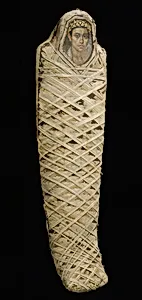
Medium
Human remains wrapped with linen and mummification material; panel portrait: encaustic on limewood
Dimensions
Mummy: L. 169 cm (66 9/16 in.); W. 45 cm (17 11/16 in.); Panel as exposed: H. 38.1 cm (15 in.); W. 18 cm (7 1/16 in.)
Classification
Mummy, youth, panel portrait
Period
Roman Period
Department
Egyptian Art
Museum
Metropolitan Museum of Art, New York, NY
Credit
Rogers Fund, 1911
Accession Number
11.139
Rights
Public Domain
Tags
About this artwork
This work exemplifies the artistic traditions of Roman Period, Fayum. Created A.D. 80–100, it demonstrates the human remains wrapped with linen and mummification material; panel portrait: encaustic on limewood technique characteristic of its era.
Art Historical Context
This striking mummy from the Roman Period in Egypt, dated A.D. 80–100, beautifully illustrates the cultural fusion of ancient Egyptian burial traditions with Roman artistic influences. Originating from the Fayum region, it features the preserved remains of a young man wrapped in linen and mummification materials, with a lifelike panel portrait inserted over the face. Such works reflect how Egyptian practices of preparing the dead for the afterlife adapted under Roman rule, blending local customs with the empire’s emphasis on individual identity. The portrait itself stands out for its remarkable realism, painted in encaustic—a technique using heated beeswax mixed with pigments—on limewood. This method allowed artists to achieve rich colors, subtle shading, and a sense of depth that captures the youth’s features with striking immediacy. As one of the finest surviving examples of Fayum mummy portraits, it offers visitors a rare glimpse into the personal lives of people living at the crossroads of two great civilizations. Housed in the Metropolitan Museum of Art’s Egyptian Art department, this piece highlights the enduring human desire to be remembered. Its presence in the collection, acquired through the Rogers Fund in 1911, continues to connect modern audiences with the intimate stories of the ancient world.