
Murnau
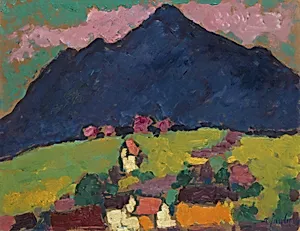
Medium
oil on hardboard
Dimensions
overall: 32.9 x 42.3 cm (12 15/16 x 16 5/8 in.) framed: 46.5 x 56.2 x 4.7 cm (18 5/16 x 22 1/8 x 1 7/8 in.)
Classification
Painting
Department
CMC
Museum
National Gallery of Art, Washington, D.C.
Credit
Gift of Mr. and Mrs. Ralph F. Colin
Accession Number
1973.69.1
Rights
Public Domain
Art Historical Context
**Murnau** (1910) by Alexej von Jawlensky captures the vibrant essence of the Bavarian village that inspired it, painted in oil on hardboard—a compact panel measuring about 33 x 42 cm. Jawlensky, a Russian-born artist who settled in Germany, rendered this landscape with bold colors and simplified forms, evoking the emotional intensity of early Expressionism. The choice of hardboard as a support allowed for a smooth surface ideal for his direct, impasto-like brushwork, departing from traditional canvas to emphasize texture and immediacy. In 1909, Jawlensky joined fellow innovators Wassily Kandinsky and Gabriele Münter in Murnau, south of Munich, forming a creative hub that fueled the Blaue Reiter (Blue Rider) movement by 1911. This painting marks that pivotal transition, blending Fauvist influences—vibrant hues and expressive distortion—with a nascent abstraction. It reflects the group's quest to convey spiritual depth through nature, predating Jawlensky's later iconic "heads." Today, housed in the National Gallery of Art as a gift from Mr. and Mrs. Ralph F. Colin, **Murnau** invites visitors to feel the artist's joyful response to alpine light and color, bridging Impressionism's legacy with modernism's bold vision.