
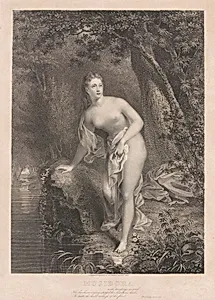
Musidora
Medium
engraving in black on laid paper
Dimensions
image: 36.99 × 27.15 cm (14 9/16 × 10 11/16 in.) plate: 43.02 × 30.8 cm (16 15/16 × 12 1/8 in.) sheet: 47.15 × 33.5 cm (18 9/16 × 13 3/16 in.)
Classification
Department
CG-W
Museum
National Gallery of Art, Washington, D.C.
Credit
Corcoran Collection (Museum Purchase, Mary E. Maxwell Fund)
Accession Number
2015.19.601
Rights
Public Domain
Art Historical Context
**Musidora** *Asher Brown Durand, 5* Engraving in black on laid paper into the refined world of early 19th-century Americanmaking with Asher B. Durand's *Musora* (1825), an engraving capturing a moment of classical reverie. Durand, a pioneering figure who would later co-found the Hudson River School of landscape painting began his career as a engraver. This work the poetic scene from James Thomson's *The Seasons*, where the nymph Musidora bathes unaware, evoking themes of natural beauty and voyeuristic innocence popular in neoclassical art. Crafted on laid paper—distinguished by its subtle chain lines from the manufacturing mold—the engraving showcases Durand's technical prowess. He meticulously incised fine lines into a metal plate, creating intricate textures for skin, water, and foliage that translate vividly in black ink. Measuring nearly 37 x 27 cm for the image alone, the print's generous plate and sheet sizes allowed for detailed reproduction, making high art accessible beyond elite circles. Acquired through the Corcoran Collection at the National Gallery of Art, *Musidora* highlights engraving's role in bridging European traditions with emerging American identity. It marks Durand's early versatility, blending precision craftsmanship with romantic sensibility, and invites visitors to appreciate how prints democratized beauty in a young nation. (198 words)
About the Artist
Asher Brown Durand · 1796–1886
Was a principal member of the Hudson River School. American artist; associated with the Hudson River School of landscape painting. Comment on works: Portraits