
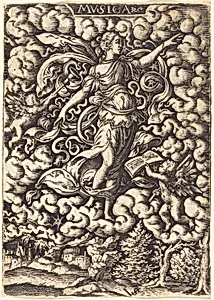
Mvsica (Music)
1501 to 1550
Medium
engraving
Classification
Department
CG-E
Museum
National Gallery of Art, Washington, D.C.
Credit
Rosenwald Collection
Accession Number
1943.3.7973
Rights
Public Domain
Art Historical Context
**Mvsica (Music)** Virgil Solis (c. 1501–1550) is a captivating engraving from the Renaissance era, housed in the National Gallery of's Rosenwald Collection (Department CG-E). This print exemplifies Solis's mastery as a Nuremberg-based artist, renowned for his intricate designs that brought classical and allegorical themes to life. Likely part of a series personifying the liberal arts, *Mvsica* depicts Music as an elegant figure, symbolizing harmony and intellectual pursuit in the humanist spirit of the 16th. Engraving, Solis's preferred medium, allowed for precise line work and widespread distribution—revolutionary for its time. Unlike paintings reserved for the elite, these prints democratized art, adorning homes and studios across Europe. Solis, influenced by Albrecht Dürer, employed fine hatching and cross-hatching to create depth, texture, and movement, making abstract concepts like music visually tangible through instruments and graceful poses. Culturally, *Mvsica* reflects the Renaissance revival of antiquity, where music was celebrated as a bridge between the divine and human realms. Visitors to the National Gallery can appreciate how Solis's work captures this era's blend of artistry and philosophy, inviting us to ponder the timeless rhythm of creativity.