
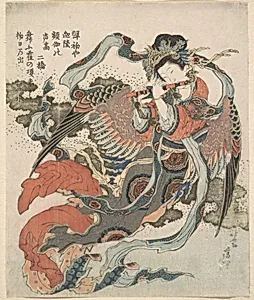
Mystical Bird (Karyōbinga)
1820–33
Medium
Woodblock print (surimono); ink and color on paper
Dimensions
8 9/16 x 7 1/16 in. (21.7 x 17.9 cm)
Classification
Prints
Culture & Period
Japan · Edo period (1615–1868)
Department
Asian Art
Museum
Metropolitan Museum of Art, New York, NY
Credit
H. O. Havemeyer Collection, Bequest of Mrs. H. O. Havemeyer, 1929
Accession Number
JP1868
Rights
Public Domain
Tags
Art Historical Context
Katsushika Hokus's *Mystical Bird (Karyōbinga)*, created between 1820 and 1833 during Japan's Edo period (1615–1868), captures ethereal beauty of a mythical creature from Buddhist lore. The karyōbinga, a celestial bird-woman symbolizing divine music and enlightenment, is depicted with delicate grace, blending human elegance with avian features. Hokusai, a master of ukiyo-e—the "pictures of the floating world"—infuses this intimate print with his signature dynamism and precision, evoking the era's fascination with nature, fantasy, and the supernatural. This surimono, a luxurious woodblock print commissioned for private patrons (often New Year's greetings), showcases advanced techniques like vibrant inks, subtle color gradients (bokashi), and fine carving for intricate details in feathers, robes, and musical instruments. Measuring just 8 9/16 x 7 1/16 inches, its small scale belies its technical brilliance, highlighting Edo Japan's thriving print culture where artists like Hokusai democratized art for poetry-loving elites. Housed in the Metropolitan Museum of Art's Asian Art collection, this piece from the H. O. Havemeyer bequest invites visitors to ponder the harmony of sound and spirit, a timeless motif in Japanese aesthetics. Spot the lute-like instrument and flowing plumage—perfect for losing yourself in Hokusai's whimsical world!
About the Artist
Katsushika Hokusai · 1760–1849
Katsushika Hokusai (1760-1849) stands as one of history's most influential artists, a Japanese master who revolutionized the ukiyo-e woodblock print tradition and profoundly shaped Western art. Born in the Katsushika district of Edo (modern-day Tokyo) to an artisan family, Hokusai lived through nearly nine decades of extraordinary creative evolution, adopting over thirty different artistic names t...