
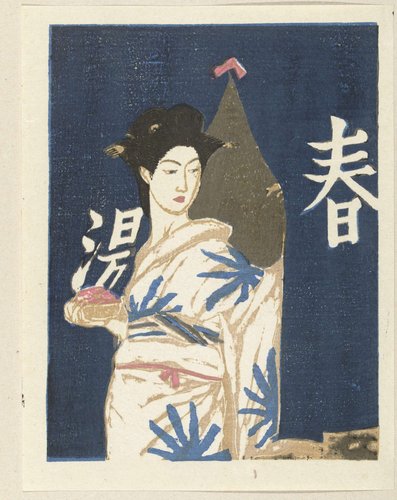
Na het bad
1946
Medium
color woodcut
Dimensions
250; 266; 332; 263
Rights
Public Domain
About this artwork
Purchased with the support of the F.G. Waller-Fonds
Art Historical Context
**Na het bad (After the Bath)**, a delicate color woodcut by Japanese artist Onchi Kōshirō from 1946, captures intimate post-war moment of quiet repose. Created just a year after World War II's end, this print reflects Japan's artistic resurgence amid reconstruction. Onchi (1891–1955), a leading figure in the *sōsaku hanga* (creative print) movement, championed individual expression over traditional collaborative methods, blending Eastern woodblock traditions with modernist abstraction. The title, Dutch for "After the Bath," hints at its place in international collections, evoking universal themes of vulnerability and renewal. Measuring a modest 266 × 250 mm, the work exemplifies the precision of color woodcut technique: multiple carved blocks are inked in vibrant hues and meticulously layered to achieve subtle gradients and textures. This labor-intensive process, rooted in ukiyo-e yet innovated by Onchi's experimental style, allowed for bold compositions that pushed boundaries in post-war Japanese printmaking. Acquired with support from the F.G. Waller-Fonds, *Na het bad* stands as a testament to cross-cultural appreciation. Its small scale invites close viewing, revealing Onchi's mastery in conveying serenity and human form—perfect for contemplation in our virtual galleries.