
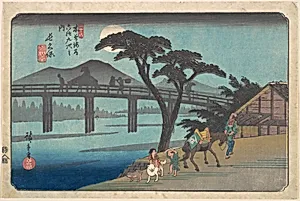
木曽海道六拾九次之内 長久保|Nagakubo
1797–1858
Medium
Woodblock print; ink and color on paper
Dimensions
9 7/8 x 14 7/8 in. (25.1 x 37.8 cm)
Classification
Prints
Culture & Period
Japan · Edo period (1615–1868)
Department
Asian Art
Museum
Metropolitan Museum of Art, New York, NY
Credit
Henry L. Phillips Collection, Bequest of Henry L. Phillips, 1939
Accession Number
JP2869
Rights
Public Domain
Tags
Art Historical Context
Utagawa Hiroshige1797–1858), a master of ukiyo-e woodblock, captures the rugged beauty of Japan's Edo-period travel routes in *Nagakubo*, from his renowned series *The Sixty-nine of the Kiso Kō* (c. 1835–1839). This print depicts the post station at Nagakubo the mountainous Kiso Road, an inland alternative to the coastal Tōkaidō. Hiroshige's keen eye for nature and human activity brings to life a bustling scene: travelers on horseback cross a bridge, framed by sturdy houses, lush trees, and towering mountains under a vast sky. Woodblock printing, using ink and color on paper, allowed Hiroshige's vibrant landscapes to reach everyday Japanese audiences affordably. His signature style—delicate gradations of color (bokashi technique) and atmospheric perspective—evokes the transient beauty of *mono no aware*, blending realism with poetic emotion. Measuring about 10 x 15 inches, this intimate format was perfect for collectors and travelers alike. Part of the Metropolitan Museum of Art's Henry L. Phillips Collection, *Nagakubo* reflects Edo Japan's fascination with pilgrimage and commerce, immortalizing a world of foot-weary samurai, merchants, and porters navigating perilous paths. Hiroshige's series influenced global artists like Van Gogh, cementing ukiyo-e's enduring legacy in bridging East and West.
About the Artist
Utagawa Hiroshige · 1826–1869
Utagawa Hiroshige (1797–1858), born Andō Tokutarō, was the last great master of Japanese ukiyo-e woodblock printmaking and one of the most influential landscape artists in history. Born in Edo (modern Tokyo) into a low-ranking samurai family serving as fire wardens, Hiroshige transformed landscape printmaking into a poetic meditation on nature, weather, and everyday life. His revolutionary approac...