
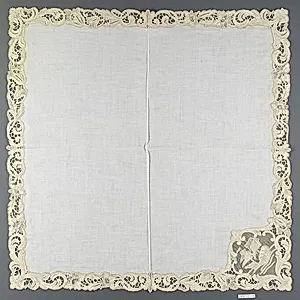
Napkin (from a set of table linens)
Unknown Artist
late 19th century
Medium
Linen, needle lace
Dimensions
Ca.: H. 19 1/2 x L. 19 1/2 inches 49.5 cm
Classification
Textiles-Laces
Culture
Belgian
Department
European Sculpture and Decorative Arts
Museum
Metropolitan Museum of Art, New York, NY
Credit
Gift of Jane M. Bingham, 1980
Accession Number
1980.520.15
Rights
Public Domain
Art Historical Context
This delicate napkin, part of a luxurious set of table linens hails from late 19th-century Belgium a golden era for European lace production. Crafted from fine linen adorned with intricate needle lace, it measures approximately 19½ x 19½ inches, for elegant dining tables of the bourgeoisie. Needle lace, a labor-intensive technique where threads are individually stitched and knotted by hand to form elaborate patterns, showcases the artisan's precision and patience—often requiring hundreds of hours per piece. Belgian lace, particularly from Flanders, was renowned worldwide during this period, symbolizing refinement and national pride. Exported across Europe and beyond, these textiles graced aristocratic homes and reflected the era's opulent domestic culture, where fine linens elevated everyday meals into displays of wealth and taste. Though the artist remains unknown, the work exemplifies the high craftsmanship of anonymous lacemakers, whose skills sustained a vital industry amid industrialization. Today, this napkin resides in The Metropolitan Museum of Art's European Sculpture and Decorative Arts Department, a gift from Jane M. Bingham in 1980. It invites us to appreciate the artistry in overlooked objects, reminding visitors of lace's role as both functional beauty and cultural heritage.