
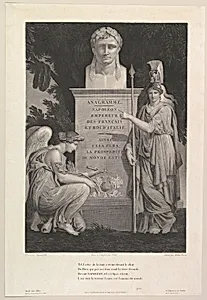
Napoléon, Emperor of the French
Medium
Etching and engraving on laid paper
Dimensions
image: 18 1/16 x 12 5/8 in. (45.8 x 32 cm) plate: 22 13/16 x 15 3/8 in. (58 x 39.1 cm)
Classification
Prints
Department
Drawings and Prints
Museum
Metropolitan Museum of Art, New York, NY
Credit
Gift of James Draper, in memory of Kathleen Howard, 2006
Accession Number
2006.150.1
Rights
Public Domain
Tags
Art Historical Context
Created in 1811 at the zenith of Napoleon Bonaparte's imperial reign, *Napoléon, Emperor of the French* is a collaborative print by French artists Alexandre Evariste Fragonard—son of the famed Rococo master Jean-Honoré Fragonard—alongside Henri Castel, Madame Benoist (the neoclassical portraitist Marie Guilhelmine Benoist), and Marcelle. This etching and engraving on laid paper captures the Emperor's commanding presence, reflecting the era's fervor for heroic imagery. Measuring nearly 23 by 15 inches at plate size, it exemplifies how printmaking democratized art, allowing Napoleonic portraits to proliferate across Europe as symbols of power and national pride. The medium's significance lies in its technical precision: etching creates fluid, spontaneous lines, while engraving adds rich tonal depth, ideal for conveying imperial grandeur on affordable paper. Produced amid Napoleon's conquests, such prints served as propaganda tools, fostering loyalty and cult-like devotion. Notably, the involvement of women artists like Madame Benoist highlights their emerging roles in a male-dominated field, blending neoclassical poise with revolutionary spirit. Today, this work resides in the Metropolitan Museum of Art's Drawings and Prints department, a gift honoring Kathleen Howard. It invites us to ponder how art immortalized an emperor whose empire, though fleeting, reshaped history.