
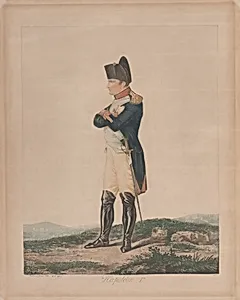
Napoleon I
Medium
Etching, aquatint, and roulette printed in color
Dimensions
Plate: 15 15/16 × 12 1/2 in. (40.5 × 31.7 cm) Sheet: 18 5/16 × 13 3/4 in. (46.5 × 35 cm)
Classification
Prints
Department
Drawings and Prints
Museum
Metropolitan Museum of Art, New York, NY
Credit
Gift of Robert Gifford Berry and Christiane Laus Berry, in memory of Louise Duval Lefebvre, 2003
Accession Number
2003.247
Rights
Public Domain
Tags
Art Historical Context
This vibrant color print, *Napoleon I* (1807), captures the French Emperor at the zenith of power, created by Louis Philibert Debourt, a pioneering French engraver. Debucourt, active during the Revolutionary and Napoleonic eras, specialized in innovative color printing techniques that brought paintings to life on paper. Here, he employs etching for precise lines, aquatint for tonal gradients mimicking watercolor, and roulette—a toothed wheel—for textured color effects, resulting in a richly hued portrait printed directly in multiple colors without hand-coloring. Dated 1807, the work reflects Napoleon's imperial dominance following victories at Austerlitz and Jena, a time when his image was propagated through prints to foster national pride and loyalty across Europe. Such affordable reproductions democratized access to heroic imagery, blending propaganda with artistry in the Prints department of the Metropolitan Museum of Art. Debucourt's mastery of these methods elevated printmaking from mere reproduction to a standalone medium, influencing later color lithography. Measuring about 16 by 12 inches on the plate, this gift to the Met in 2003 offers visitors a window into early 19th-century visual culture, where technical innovation met political iconography.