
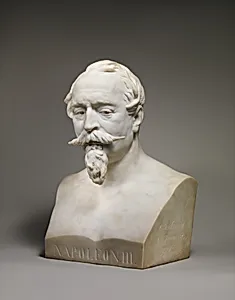
Napoléon III (1808–1873), Emperor of the French
Jean-Baptiste Carpeaux, 1873
About this artwork
This striking marble bust of Napoléon III, Emperor of the French (1808–1873), the visage of the last monarch to rule France, sculpted by Jean-Baptiste Carpe in the very year of the emperor's death. Carpeaux, a leading artist of the Second Empire, renowned for his dynamic realism and emotional expressiveness, blending neoclassical precision with romantic vitality. Created in Paris, this 20½ × 14½ × 11⅜-inch work exemplifies the era's grand portrait tradition, where sculpture served as both personal memorial and political statement. Dated 1873, the bust arrived amid the turmoil following France's defeat in the Franco-Prussian War and the fall of the Second Empire in 1870, which led to Napoléon III's exile and demise in England. As a posthumous tribute, it immortalizes a ruler whose 18-year reign modernized Paris under Baron Haussmann while sowing the seeds of republicanism. Carpeaux's masterful carving of marble—polished to highlight the emperor's stern features, imperial gaze, and textured attire—showcases the medium's enduring prestige for elite portraiture, evoking the heroic busts of antiquity while grounding them in 19th-century naturalism. Today, housed in the Metropolitan Museum of Art's European Sculpture and Decorative Arts department, this piece invites reflection on empire's fragility and art's power to preserve legacy.