
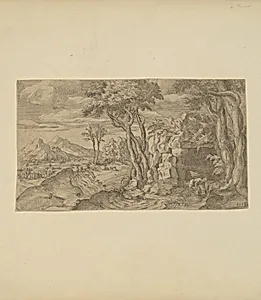
Narcissus
late 16th century
Medium
etching on laid paper
Dimensions
sheet: 16 × 28.2 cm (6 5/16 × 11 1/8 in.)
Classification
Department
CG-E
Museum
National Gallery of Art, Washington, D.C.
Credit
Gift of Alessandra Manning Dolnier
Accession Number
2018.113.2
Rights
Public Domain
Art Historical Context
Étienne Dupérac’s late-16th-century etching “Narcissus” invites viewers into the ancient Greek myth of the youth who falls in love with his own reflection. Working in France and Italy during a period when classical stories were widely revisited, Dupérac used the story to explore themes of vanity and self-knowledge that resonated with Renaissance audiences. The modest sheet size—roughly 16 by 28 centimeters—suggests the print was made for private collectors who could appreciate its fine detail at close range. Etching on laid paper was a favored technique of the era, allowing artists to achieve delicate lines and atmospheric effects by drawing through a wax ground before acid bit the copper plate. Dupérac’s skillful use of this medium helped disseminate mythological imagery beyond painted canvases, making classical narratives accessible to a growing audience of print enthusiasts. Gifted to the National Gallery of Art by Alessandra Manning Dolnier, the work remains a quiet testament to how Renaissance printmakers bridged ancient tales with the visual culture of their own time.