
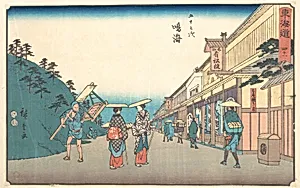
東海道五十三次 鳴海 名産絞り店|Narumi
ca. 1840
Medium
Woodblock print; ink and color on paper
Dimensions
Overall: 8 3/4 x 13 3/4in. (22.2 x 34.9cm)
Classification
Prints
Culture & Period
Japan · Edo period (1615–1868)
Department
Asian Art
Museum
Metropolitan Museum of Art, New York, NY
Credit
The Francis Lathrop Collection, Purchase, Frederick C. Hewitt Fund, 1911
Accession Number
JP791
Rights
Public Domain
Tags
Art Historical Context
Utagawa Hiroshige *Narumi* (ca. 1840) is a vibrant woodblock print his celebrated series *The 53 of the Tōkaidō*, which immortalizes the post stations along Japan's historic coastal highway from Edo (modern Tokyo) to Kyoto. This scene captures the lively street of Narumi, the 42nd station, renowned for its tie-dye (shibori) shops—hence the subtitle "Famous for Tie-Dye Stores." Hiroshige masterfully depicts everyday travelers, merchants, men, and women bustling amid shopfronts, evoking the energy of Edo-period life during Japan's Tokugawa shogunate (1615–1868). As a pinnacle of ukiyo-e ("pictures of the floating world"), Hiroshige's style emphasizes atmospheric perspective, subtle gradations of color, and poetic glimpses of urban-rural life. Printed with ink and color on paper using collaborative woodblock techniques—where carvers, printers, and publishers layered pigments for luminous effects—this affordable medium democratized art, reaching a wide audience beyond elites. Measuring about 9 x 14 inches, this print from the Metropolitan Museum of Art's Francis Lathrop Collection offers a window into 19th-century Japan's travel culture, where the Tōkaidō was a vital artery for pilgrims, samurai, and merchants, blending commerce, community, and quiet beauty.
About the Artist
Utagawa Hiroshige · 1826–1869
Utagawa Hiroshige (1797–1858), born Andō Tokutarō, was the last great master of Japanese ukiyo-e woodblock printmaking and one of the most influential landscape artists in history. Born in Edo (modern Tokyo) into a low-ranking samurai family serving as fire wardens, Hiroshige transformed landscape printmaking into a poetic meditation on nature, weather, and everyday life. His revolutionary approac...