
Nathaniel Pearce
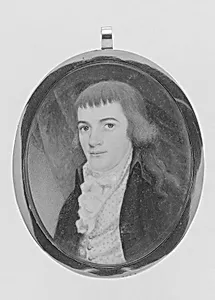
Medium
Watercolor on ivory
Dimensions
2 3/8 x 2 in. (6 x 5 cm)
Classification
Painting, miniature
Culture
American
Department
The American Wing
Museum
Metropolitan Museum of Art, New York, NY
Credit
Gift of Gloria Manney, 2006
Accession Number
2006.235.106
Rights
Public Domain
Tags
Art Historical Context
In the late 18th century, America emerged from the Revolutionary War into the Federal era, intimate portrait miniatures like Edward Greene Malbone's *iel Pearce* (179) captured the likenesses of prominent citizens. This delicate watercolor on ivory, measuring just 2 3/8 x 2 inches, depicts the sitter—likely a New England merchant or professional—with remarkable precision and warmth. Malbone, one of America's premier miniaturists active from the 1790s to 1807, honed his craft in Providence, Rhode Island, and later itinerant travels, drawing from English traditions while infusing a distinctly American vitality. The medium of watercolor on ivory was ideal for these jewel-like portraits, often worn in lockets or brooches as personal mementos exchanged among family and sweethearts. Malbone's virtuoso technique shines in the subtle layering of translucent pigments, achieving lifelike skin tones, expressive eyes, and fine details like lace cuffs on ivory's smooth, luminous surface. This piece exemplifies the height of the miniature portrait tradition before photography's rise. Housed in The Metropolitan Museum of Art's American Wing, *Nathaniel Pearce* highlights the cultural role of such artworks in fostering personal identity and social connections in early republic society. A gift from Gloria Manney in 2006, it invites visitors to marvel at an era when portraiture was both art and cherished heirloom.
About the Artist
Edward Greene Malbone · 1777–1807
1777–1807