
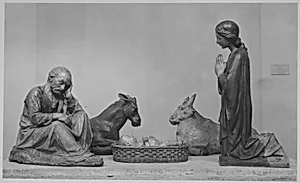
Nativity (five figures forming a presepio)
15th century
Medium
Painted terracotta
Dimensions
Height (Joseph .1): 24 1/2 in. (62.2 cm); Height (Mary .2): 34 7/8 in. (88.6 cm); Length (Christ Child .3): 17 1/2 in. (44.5 cm); Height (Ox .4): 17 1/2 in. (44.5 cm); Height (Ass .5): 17 1/2 in. (44.5 cm)
Classification
Sculpture
Culture
Italian, Florence
Department
European Sculpture and Decorative Arts
Museum
Metropolitan Museum of Art, New York, NY
Credit
Rogers Fund, 1911
Accession Number
11.136.1–.5
Rights
Public Domain
Tags
Art Historical Context
Antonio Rossellino’s *Nativity* brings the story of Christ’s birth vividly to life through five painted terracotta figures that together form a traditional Italian presepio, or nativity scene. Created in fifteenth-century Florence, the ensemble captures the quiet wonder of the moment with the Virgin Mary, Saint Joseph, the Christ Child, and the humble ox and ass. Rossellino, a leading sculptor of the Florentine Renaissance, worked in a period when artists sought to infuse religious subjects with natural human warmth and lifelike detail. The choice of painted terracotta was both practical and expressive. Terracotta allowed sculptors to model soft drapery and gentle expressions with relative ease, while the polychromy—now softly faded—once gave the figures a colorful, almost living presence suitable for church or household devotion. Each figure was made separately, inviting viewers to arrange them in intimate, storytelling groupings that emphasized the humanity of the Holy Family. Today these sculptures, acquired by the Metropolitan Museum in 1911, offer a rare glimpse into Renaissance devotional art. Their modest scale and tender modeling remind us how Florentine artists like Rossellino helped make sacred stories feel immediate and deeply personal for everyday worshippers.
About the Artist
Antonio Rossellino · 1427–1479
Comment on works: sculptor