
Natural Trumpet
late 17th century
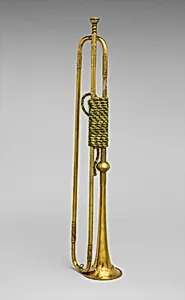
Medium
Brass
Dimensions
Depth (Without crook or mouthpiece): 25 11/16 in. (65.3 cm) Diameter (Of bell): 4 7/16 in. (11.3 cm)
Classification
Aerophone-Lip Vibrated
Culture
German
Department
Musical Instruments
Museum
Metropolitan Museum of Art, New York, NY
Credit
The Crosby Brown Collection of Musical Instruments, 1889
Accession Number
89.4.2375
Rights
Public Domain
Art Historical Context
Step into the late 17th-century world of German craftsmanship with this stunning *Natural Trumpet* by Johann Wilhelm Haas, a master instrument maker from Nuremberg. Fashioned entirely from brass, this elegant aerophone—classified as lip-vibrated—represents the pinnacle of pre-valve trumpet design. Without modern valves, it relied solely on the player's embouchure and breath control to produce a brilliant harmonic series, evoking the fanfares of royal courts, military signals, and early Baroque ensembles. Haas's work exemplifies the technical artistry of the era, where brass was prized for its resonant tone and malleability, allowing for seamless tubing and a flared bell measuring 4 7/16 inches (11.3 cm) in diameter. The trumpet's slender form, with a depth of 25 11/16 inches (65.3 cm) without crook or mouthpiece, highlights the precision required for such instruments, which demanded virtuoso skill from performers like those in the courts of Europe. Housed in The Metropolitan Museum of Art's Crosby Brown Collection of Musical Instruments (acquired 1889), this piece offers a tangible link to Germany's rich musical heritage. It invites us to imagine the triumphant blasts that accompanied history's grand moments, bridging artistry and sound in a single, gleaming artifact.
About the Artist
Johann Wilhelm Haas · 1649–1723
German, Nuremberg 1649–1723 Nuremberg