
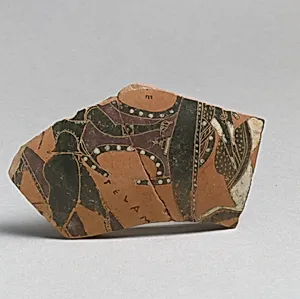
Neck-amphora, Tyrrhenian fragments
ca. 575–550 BCE
Medium
Terracotta
Dimensions
2 1/4 × 3 11/16 in. (5.7 × 9.3 cm)
Classification
Vases
Culture & Period
Greek, Attic · Archaic
Department
Greek and Roman Art
Museum
Metropolitan Museum of Art, New York, NY
Credit
Gift of Miss Matilda W. Bruce, 1907 (07.156.7) Gift of Mario Astarita, 1956 (56.128)
Accession Number
56.128
Rights
Public Domain
Art Historical Context
This delicate neck-amphora, crafted by the Prometheus Painter around 575–550 BCE, exemplifies the vibrant world of Attic black-figure pottery during Greece's Archaic period. Though surviving only as fragments—measuring a modest 2¼ × 3⅝ inches—these terracotta pieces once formed a two-handled storage jar, typical of the Tyrrhenian Group. Named for their popularity among Etruscan traders (the "Tyrrhenians"), such vases were exported widely, blending Greek mythology with everyday utility and serving as cultural ambassadors. The Prometheus Painter, active in Athens, mastered the black-figure technique: artisans incised details into glossy black slip fired onto red-orange clay, creating stark contrasts for dynamic figures. These small-scale works often featured lively scenes of gods, heroes, and revelers, showcasing the artist's bold linearity and narrative flair. As part of the Metropolitan Museum of Art's Greek and Roman collection—gifted in 1907 and 1956—this artifact highlights Archaic innovation, bridging pottery's functional roots with emerging artistic storytelling. Despite its fragmented state, the amphora whispers of ancient maritime trade and elite tastes, inviting us to imagine the myths it once bore across the Mediterranean.