
Necklace
Unknown Artist
ca. 1981–1295 B.C.
Medium
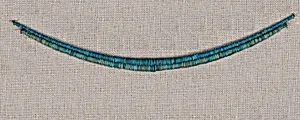
Blue faience
Dimensions
l. 38.5 cm (15 3/16 in)
Classification
Necklace, beads
Period
Middle Kingdom–Early New Kingdom
Department
Egyptian Art
Museum
Metropolitan Museum of Art, New York, NY
Credit
Rogers Fund, 1915
Accession Number
15.3.462
Rights
Public Domain
Art Historical Context
This exquisite necklace, crafted from vibrant blue faience around 1981–1295 B.C. during Egypt's Middle Kingdom to Early New Kingdom (Dyn 12–18), the ancient Egyptians' mastery of affordable yet luxurious materials. Faience, a glazed composite of quartz, lime, and clay fired to a brilliant turquoise hue, mimicked the prized deep-blue lapis lazuli— imported at great cost from afar. Measuring 38.5 cm in length, this piece would have draped elegantly around the neck, its glassy sheen evoking the Nile's life-giving waters. In ancient Egyptian culture, such jewelry transcended mere adornment, serving as powerful amulets for protection, fertility, and rebirth. Worn by both elites and commoners, blue faience symbolized the heavens, eternity, and the goddess Hathor, blending everyday piety with artistic ingenuity. Techniques involved molding beads or pendants, applying a copper-based glaze, and firing at low temperatures, allowing mass production while retaining a jewel-like glow that has endured millennia. Acquired through the Rogers Fund in 1915 and now housed in the Metropolitan Museum of Art's Egyptian Art department, this necklace offers a window into a dynamic era of pharaonic innovation—from the stable prosperity of Dynasty 12 to the imperial heights of Dynasty 18 under rulers like Hatshepsut and Tutankhamun. Visitors, imagine its cool weight against sun-kissed skin, whispering tales of immortality.