
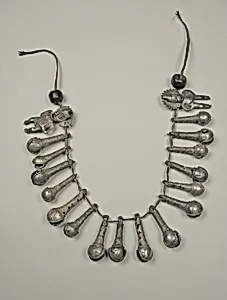
Necklace with bells and two figures
Unknown Artist
16th century (?)
Medium
Silver
Dimensions
W. 1 11/16 in. (4.3 cm)
Classification
Metal-Ornaments
Culture
Peruvian
Department
Arts of Africa, Oceania, and the Americas
Museum
Metropolitan Museum of Art, New York, NY
Credit
Museum Purchase, 1899
Accession Number
99.34
Rights
Public Domain
Tags
Art Historical Context
This delicate silver necklace, hailing from Peruvian culture and tentatively dated to the 16th century, exemplifies exquisite metalwork of the Andes. Measuring just 1 11/16 inches (4.3 cm) wide, it features bells and two small figures, blending ornamentation with functionality. Crafted from silver—a metal revered in pre-Columbian societies for its luster and association with the moon god—such pieces were likely worn as jewelry or ritual accessories, showcasing advanced techniques like casting and soldering honed by cultures such as the Inca or their predecessors. The inclusion of bells tags this as a musical instrument, suggesting it jingled rhythmically during ceremonies, dances, or processions, invoking spiritual or communal energies. In Peruvian Andean traditions, wearable art like this held profound cultural significance, symbolizing status, fertility, or protection. The enigmatic figures may represent deities or ancestors, though their exact meaning remains a tantalizing mystery. Acquired by the Metropolitan Museum of Art in 1899, this necklace invites visitors to ponder the lives of its ancient wearers, bridging the vibrant world of indigenous Peru with our modern gaze. A testament to enduring artistry, it whispers of rituals lost to time.