
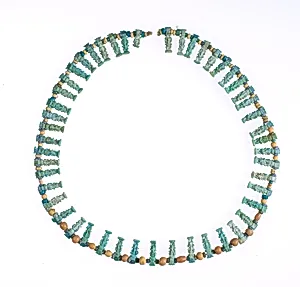
Necklace with Bes amulets
Unknown Artist
ca. 1991–1450 B.C.
Medium
Yellow, green and blue faience
Dimensions
l. 40 cm (15 3/4 in)
Classification
Necklace, Bes amulets
Period
Second Intermediate Period–Early New Kingdom
Department
Egyptian Art
Museum
Metropolitan Museum of Art, New York, NY
Credit
Purchase, Edward S. Harkness Gift, 1926
Accession Number
26.7.1373
Rights
Public Domain
Art Historical Context
### Necklace with Bes Amulets This striking necklace, dating to the Second Intermediate Period through the Early New Kingdom (ca. 1991–1450 B.C.), showcases the ancient Egyptians' devotion to protection and vibrant aesthetics. Crafted from faience—a glazed ceramic prized for its jewel-like sheen and affordability—the piece features yellow, green, and blueulets depicting Bes, a popular dwarf-like deity. Stretching 40 cm (15 3/4 in.) long, it would have adorned the neck as both jewelry and talisman, now housed in the Metropolitan Museum of Art's Egyptian Art Department, thanks to the 1926 Edward S. Harkness Gift. Bes, with his fierce grimace, lion-like mane, and plump form, was a household guardian against evil spirits, particularly safeguarding women during childbirth and children from harm. Amulets like these were ubiquitous in daily life, reflecting the era's turbulent transitions—from Hyksos foreign rule to the resurgence of native pharaohs in the New Kingdom. The necklace's multiple Bes figures strung together amplified its apotropaic power, a clever fusion of piety and personal adornment. Faience's glassy frit allowed artisans to mimic precious stones like lapis lazuli (blue) and turquoise (green), democratizing luxury. This technique highlights Egyptian ingenuity in mass-producing colorful, durable objects that bridged art, religion, and everyday protection, offering a window into a culture where beauty warded off chaos.