
Nefertum
Unknown Artist
664–30 B.C.
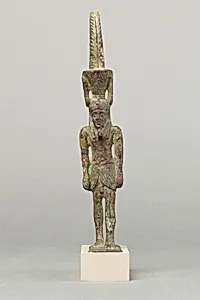
Medium
Cupreous metal
Dimensions
H. 17.7 cm (6 15/16 in.); W. 2.7 cm (1 1/16 in.); D. 5.7 cm (2 1/4 in.)
Classification
Statuette, Nefertum
Period
Late Period–Ptolemaic Period
Department
Egyptian Art
Museum
Metropolitan Museum of Art, New York, NY
Credit
Gift of Darius Ogden Mills, 1904
Accession Number
04.2.455
Rights
Public Domain
Art Historical Context
Behold the exquisite bronze figurine of *Nefertum*, a youth from ancient Egypt's Late Period to Ptolemaic era (664–30 B.C.). Crafted by an unknown artist in cupreous metal—a copper alloy prized for its durability and golden sheen—this small votive statue stands just 17.7 cm tall, embodying the god's youthful grace. Nefertum, son of the creator god Ptah and the lioness Sekhmet, was revered as the lord of the lotus flower,izing rebirth, beauty, and healing. Worshipped especially in Memphis, he often appears with a lotus headdress, evoking the Nile's fertile cycles. During Egypt's Late and Ptolemaic periods, marked by Persian and Greek influences under the Ptolemaic dynasty, artisans preserved traditional iconography while refining casting techniques. This figurine, likely used in personal devotion or temple rituals, showcases the era's mastery of lost-wax casting, allowing intricate details on its slender form. Its compact dimensions (width 2.7 cm, depth 5.7 cm) made it portable, a cherished amulet for protection and prosperity. A gift to the Metropolitan Museum of Art from Darius Ogden Mills in 1904, *Nefertum* offers a window into Egypt's enduring spiritual world, where gods walked among mortals through such luminous metalwork.