
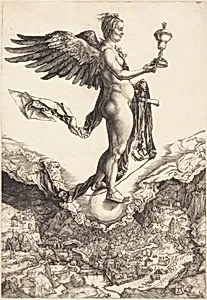
Nemesis (The Great Fortune)
c. 1501/1502
Medium
engraving on laid paper
Dimensions
plate: 33.5 x 23.3 cm (13 3/16 x 9 3/16 in.) sheet: 36 x 25.9 cm (14 3/16 x 10 3/16 in.)
Classification
Department
CG-E
Museum
National Gallery of Art, Washington, D.C.
Credit
Rosenwald Collection
Accession Number
1943.3.3485
Rights
Public Domain
Art Historical Context
Albrecht Dürer's *Nemesis (The Great)*, created around 1501–1502, is a masterful on laid paper that exemplifies the Northern Renaissance artist's revolutionary approach to printmaking. Measuring 33.5 x 23.3 cm on the, this work from the National Gallery of's Rosenwald Collection captures the Roman goddess Nemesis, divine enforcer of retribution and symbol of fate's unpredictable wheel. Perched triumphantly on a globe, she embodies the Renaissance fascination with classical mythology, blending moral allegory with the era's humanist ideals. Dürer's engraving technique shines here, with intricate cross-hatching and delicate lines achieving extraordinary depth and texture—effects rivaling painting. As a pioneer, he elevated prints from mere reproductions to collectible artworks, making complex iconography accessible to a wide audience across Europe. The subtle tonalities on laid paper highlight his precision, influenced by his Italian journeys and studies of proportion. This piece reflects early 16th-century anxieties about fortune and justice amid social upheavals, inviting viewers to ponder hubris and destiny. A cornerstone of graphic art, it showcases Dürer's genius in transforming copper plates into timeless visual poetry. (198 words)
About the Artist
Albrecht Dürer · 1471–1528
Albrecht Dürer (1471–1528) stands as the preeminent figure of the Northern Renaissance and arguably the most influential artist in the history of printmaking. Born in Nuremberg on May 21, 1471, and dying in the same city on April 6, 1528, Dürer revolutionized the status of the artist in Northern Europe, transforming printmaking from a commercial craft into an independent fine art and establishing ...