
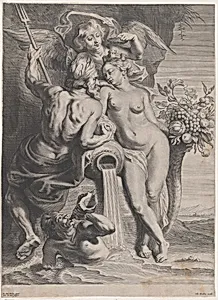
Neptune and Cybele
Medium
Engraving; second state of two (Hollstein)
Dimensions
Sheet (Trimmed): 17 1/16 × 12 7/16 in. (43.3 × 31.6 cm)
Classification
Prints
Department
Drawings and Prints
Museum
Metropolitan Museum of Art, New York, NY
Credit
The Elisha Whittelsey Collection, The Elisha Whittelsey Fund, 1951
Accession Number
51.501.7647
Rights
Public Domain
Tags
Art Historical Context
Welcome to the Metropolitan Museum of Art's Drawings and Prints collection, where *Neptune and Cybele (1640–74) captivates with its Baroque grandeur. This striking engraving, measuring 17 1/16 × 12 7/16 inches, unites the talents of Flemish master Peter Paul Rubens, renowned for his dynamic compositions and mythological themes; engraver Pieter de Jode II, who masterfully translated designs into intricate lines; and publisher Gillis Hendric. As the second state of two (per Hollstein), it represents a refined version, likely with added details enhancing its dramatic effect. Engraving, an intaglio technique where lines are incised into a metal plate and inked under pressure, was pivotal in the 17th century for disseminating Rubens's opulent visions to a wider audience beyond oil paintings. This print evokes classical mythology: Neptune, the Roman god of the sea, alongside Cybele, the powerful earth and fertility goddess, symbolizing harmony between elemental forces—a theme resonant in Baroque art's celebration of divine power and human emotion. Acquired through The Elisha Whittelsey Fund in 1951, this work exemplifies Flemish printmaking's role in cultural exchange, bridging elite patronage with public appreciation. Gaze closely at the fluid lines and rich contrasts, hallmarks of Rubens's influence, and imagine it adorning a collector's cabinet in the Dutch Golden Age.