
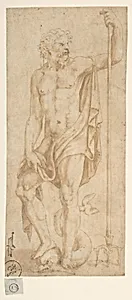
Neptune Holding a Trident and Standing on a Dolphin
1499–1546
Medium
Pen and brown ink, brush and brown wash, over black chalk
Dimensions
8 1/8 x 3 5/8in. (20.7 x 9.2cm)
Classification
Drawings
Department
Drawings and Prints
Museum
Metropolitan Museum of Art, New York, NY
Credit
Bequest of Harry G. Sperling, 1971
Accession Number
1975.131.30
Rights
Public Domain
Tags
Art Historical Context
Behold the dynamic drawing *Neptune Holding a Trident and on a Dolphin* by Giulio Romano (1499–1546), a masterful Italian Renaissance artist and pupil of Raphael. Created during Romano's prolific career, this work captures the Roman god of the sea in a poised, triumphant stance atop a sinuous dolphin, trident aloft. Romano, renowned for his Mannerist style—marked by elegant elongation and dramatic movement—likely produced this as a preparatory study for frescoes or sculptures, evoking the mythological grandeur of classical antiquity. Executed in pen and brown ink with brush and brown wash over black chalk, the piece exemplifies Renaissance drawing techniques. The subtle layering builds depth and texture: black chalk sketches the fluid forms, ink defines contours with precise hatching, and wash adds shadowy volume, bringing Neptune's muscular form and the dolphin's twisting body to life. At just 8 1/8 x 3 5/8 inches, its intimate scale invites close inspection, revealing Romano's virtuosic control. Housed in the Metropolitan Museum of Art's Drawings and Prints department (Bequest of Harry G. Sperling, 1971), this gem highlights Romano's influence on High Renaissance art, blending pagan mythology with innovative draftsmanship. Visitors, imagine Neptune surging from the waves— a timeless symbol of maritime power!
About the Artist
Giulio Romano · 1499–1546
Giulio Romano (c. 1499–1546) was the most gifted pupil of Raphael and one of the founding figures of Mannerism, the style that succeeded the High Renaissance in Italy. Born Giulio Pippi in Rome, he entered Raphael's workshop as a boy and proved so talented that by the time of Raphael's death in 1520 he was effectively running the studio and overseeing the completion of major unfinished commissions...