
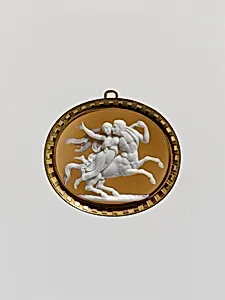
Nessus Abducting Dejanira
ca. 1815–25
Medium
Sardonyx, mounted in gold as a pendant
Dimensions
Overall: 1 15/16 x 2 1/4 in. (4.9 x 5.7 cm); visible cameo (confirmed): 40.5 x 48 mm
Classification
Lapidary Work-Gems
Culture
Italian, Rome
Department
European Sculpture and Decorative Arts
Museum
Metropolitan Museum of Art, New York, NY
Credit
Purchase, Assunta Sommella Peluso, Ada Peluso, and Romano I. Peluso Gift, in memory of Ignazio Peluso, 2004
Accession Number
2004.164
Rights
Public Domain
Tags
Art Historical Context
In the early 19th century, gem engraver Giuseppe Girometti crafted this exquisite cameo pendant in Rome, capturing the dramatic myth of Nessus abducting Dejanira. Depicting the centaur Nessus carrying Heracles' wife Dejanira—a tale from classical Greek mythology that ends in tragedy with Nessus' poisoned shirt— the work revives ancient narratives during the Neoclassical era, when artists drew inspiration from Greco-Roman stories to celebrate heroism and human drama. Carved from sardonyx, a layeredyx prized for its contrasting white and reddish-brown bands, the cameo exemplifies lapidary mastery. Girometti skillfully exploited the stone's natural strata to create a high-relief figure that pops against the darker background, a technique honed in Rome's longstanding gem-cutting tradition. Mounted in gold as a wearable pendant (just under 2 inches tall), it transformed fine art into personal jewelry, blending sculpture with decorative elegance for elite collectors. This 1815–25 piece, now in the Metropolitan Museum of Art, highlights Italy's enduring role in gem engraving, bridging antiquity and the Romantic age. Visitors might imagine it adorning a Regency-era neckline, whispering tales of passion and peril with every glance.