
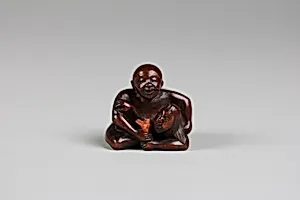
Netsuke of a Man Holding a Mermaid
Unknown Artist
18th century
Medium
Wood
Dimensions
H. 1 1/8 in. (2.9 cm); W. 1 1/4 in. (3.2 cm); D. 1 1/8 in. (2.9 cm)
Classification
Netsuke
Culture & Period
Japan · Edo (1615–1868) or Meiji period (1868–1912)
Department
Asian Art
Museum
Metropolitan Museum of Art, New York, NY
Credit
Gift of Mrs. Russell Sage, 1910
Accession Number
10.211.1726
Rights
Public Domain
Tags
Art Historical Context
This delightful netsuke, carved from wood in 18th-century Japan during the Edo (1615–1868) or possibly early Meiji (1868–1912), exemplifies the exquisite miniature sculptures that served as practical toggles. Netsuke secured inro pouches—small lacquered boxes for medicines or tobacco—to the sash of a kimono, preventing them from slipping. Popular among samurai, merchants, later collectors worldwide, these tiny carvings (just 1 1/8 inches high) transformed everyday utility into high art, showcasing Japan's mastery of intricate detail in compact form. The subject—a man cradling a mermaid—blends human tenderness with mythical allure, drawing from Japanese folklore where ningyo (mermaids) symbolized good fortune, longevity, or omens of the sea. Such whimsical motifs were common in netsuke, reflecting Edo-era fascination with the supernatural amid a prosperous, urbanizing society. The unknown artist's skillful rendering captures dynamic tension and emotion in wood, likely boxwood or similar, polished to a soft sheen. A gift to the Metropolitan Museum of Art in 1910 from Mrs. Russell Sage, this piece highlights netsuke's global appeal as both cultural artifacts and collector's treasures, inviting us to marvel at Japan's blend of functionality, fantasy, and finesse.