
Netsuke of Bird
Unknown Artist
19th century
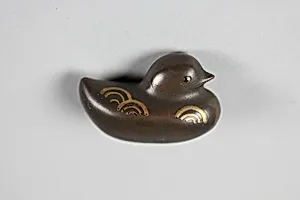
Medium
Lacquer with gold painted decoration
Dimensions
H. 1 1/8 in. (2.9 cm); L. 1 3/4 in. (4.4 cm)
Classification
Netsuke
Culture & Period
Japan · Edo (1615–1868) or Meiji period (1868–1912)
Department
Asian Art
Museum
Metropolitan Museum of Art, New York, NY
Credit
Rogers Fund, 1913
Accession Number
13.67.30b
Rights
Public Domain
Tags
Art Historical Context
This exquisite *Netsuke of Bird* is a masterful example of 19th-century Japanese craftsmanship, likely from the late Edo period (16151868) or earlyiji era (1868–1912). Carved in lacquer and adorned with delicate gold painted decoration, this tiny sculpture measures just 1 1/8 inches high and 1 3/4 inches long—perfectly pocket-sized for its original purpose. The unknown artist captured a lively bird in mid-stride, its feathers and form rendered with intricate precision that belies its miniature scale. Netsuke were essential accessories in traditional Japan, serving as toggles to secure inro pouches—small lacquered boxes for medicines, tobacco, or seals—to a kimono sash. Crafted from lacquer, a sap derived from the urushi tree, these objects showcase the painstaking roiro technique: multiple layers of lacquer applied, polished to a mirror-like sheen, and embellished with gold hiramaki-e (flat gold painting) for shimmering highlights. This medium not only ensured durability but also allowed for vibrant, symbolic motifs like birds, often representing freedom or seasonal beauty in Japanese art. Acquired through the Rogers Fund in 1913, this netsuke now graces the Metropolitan Museum of Art's Asian Art collection. It invites us to marvel at Japan's artistic ingenuity, where everyday utility met profound aesthetic refinement, transforming functional art into coveted collector's items worldwide.