
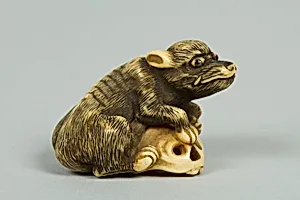
Netsuke of Boar with a Human Skull
Unknown Artist
19th century
Medium
Ivory
Dimensions
H. 1 in. (2.5 cm); W. 1 1/3 in. (3.4 cm)
Classification
Netsuke
Culture & Period
Japan · Edo (1615–1868) or Meiji period (1868–1912)
Department
Asian Art
Museum
Metropolitan Museum of Art, New York, NY
Credit
Gift of Mrs. Russell Sage, 1910
Accession Number
10.211.41
Rights
Public Domain
Tags
Art Historical Context
This delicate netsuke, carved from ivory 19th-century Japan during the late Edo (1615–1868) or early Me (1868–1912) period, depicts a fierce boar clutching a human skull in its mouth. Netsuke were ingenious miniature sculptures serving as toggles to secure inro—small lacquered pouches for medicines or seals—to a wearer's kimono sash. Practical yet artistic, they reflected the era's blend of functionality and whimsy, often worn by samurai, merchants, and townsfolk as subtle status symbols. The boar's muscular form and the skull evoke powerful symbolism: boars embodied tenacity, strength, and autumn in Japanese lore, while skulls hinted at memento mori themes or the transient nature of life, common in netsuke motifs blending humor, horror, and folklore. Carved at just 1 inch high and 1⅓ inches wide, the piece showcases masterful ivory techniques—incising details like bristly fur, sharp tusks, and bony contours with precision tools, highlighting artisans' extraordinary skill in a material prized for its creamy translucency. A gift to the Metropolitan Museum of Art from Mrs. Russell Sage in 1910, this netsuke invites visitors to ponder Japan's rich tradition of pocket-sized storytelling, where everyday objects pulsed with cultural depth.