
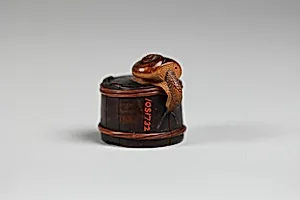
Netsuke of Snail on a Box
19th century
Medium
Wood
Dimensions
H. 1 3/8 in. (3.5 cm); W. 1 5/8 in. (4.1 cm); D. 1 1/4 in. (3.2 cm)
Classification
Netsuke
Culture & Period
Japan · Edo (1615–1868) or Meiji period (1868–1912)
Department
Asian Art
Museum
Metropolitan Museum of Art, New York, NY
Credit
Gift of Mrs. Russell Sage, 1910
Accession Number
10.211.1732
Rights
Public Domain
Tags
Art Historical Context
Behold this delightful *Netsuke of Snail on a Box a masterful 19th-century wood carving the Japanese artist Shigemasa Measuring just 1⅜ inches high, this tiny sculpture captures a snail poised elegantly atop a lidded box, showcasing the exquisite precision of netsuke craftsmanship. Netsuke were essential accessories in Edo-period (1615–1868) and Meiji-era (1868–1912) Japan, serving as toggles to secure inro—small lacquered pouches for medicines or tobacco—to one's kimono sash, blending utility with artistry. Carved from wood, Shigemasa's work exemplifies the intricate himotoshi (cord holes) and lifelike detailing typical of netsuke carvers. The snail's textured shell and deliberate posture evoke a sense of whimsy and natural observation, reflecting Japan's deep appreciation for the natural world in everyday objects. Such pieces were not mere ornaments but status symbols, often collected by samurai and merchants. Today, this charming netsuke graces the Metropolitan Museum of Art's Asian Art collection, a gift from Mrs. Russell Sage in 1910. Its snail motif, a nod to patience and quiet persistence in Japanese folklore, invites visitors to marvel at how something so small could hold such cultural weight.