
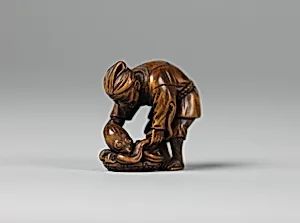
Netsuke of Snake Catcher
Unknown Artist
19th century
Medium
Wood
Dimensions
H. 1 1/2 in. (3.8 cm); W. 1 3/8 in. (3.5 cm)
Classification
Netsuke
Culture & Period
Japan · Edo (1615–1868) or Meiji period (1868–1912)
Department
Asian Art
Museum
Metropolitan Museum of Art, New York, NY
Credit
Gift of Mrs. Russell Sage, 1910
Accession Number
10.211.2242
Rights
Public Domain
Tags
Art Historical Context
This exquisite netsuke, titled *Snake Catcher*, is a masterful 19th-century Japanese wood carving depicting a man deftly handling snakes, capturing a moment of everyday daring in miniature form. Measuring just 1 1/2 inches high and 1 3/8 inches wide, its diminutive scale belies the intricate details: the textured scales of the serpents, the folds of the man's clothing, and his focused expression, all rendered in fine wood. Netsuke like this one originated during Japan's Edo period (1615–1868) or early Meiji era (1868–1912), serving as practical toggles to secure inro (small medicine or tobacco pouches) to kimono sashes, as traditional garments lacked pockets. Crafted from wood by an unknown artist, it showcases the netsuke-maker's skill in carving dense materials like boxwood or ivory substitutes, often polished to a glossy sheen for tactile appeal. These objects evolved from utilitarian items into coveted art forms, blending functionality with whimsy. Housed in the Metropolitan Museum of Art's Asian Art Department since 1910—a gift from Mrs. Russell Sage—this piece highlights Japan's rich tradition of miniature sculpture. It invites visitors to ponder the cultural fascination with snakes, symbols of renewal and peril, and the artisan's precision in evoking life from a mere carved nut-sized block.