
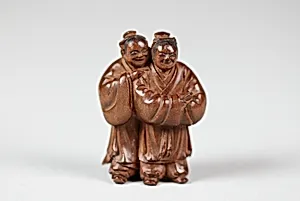
Netsuke of Two Figures
Unknown Artist
19th century
Medium
Wood
Dimensions
H. 1 3/4 in. (4.4 cm); W. 1 5/16 in. (3.4 cm)
Classification
Netsuke
Culture & Period
Japan · Edo (1615–1868) or Meiji period (1868–1912)
Department
Asian Art
Museum
Metropolitan Museum of Art, New York, NY
Credit
Gift of Mrs. Russell Sage, 1910
Accession Number
10.211.2192
Rights
Public Domain
Tags
Art Historical Context
Nestled in the Asian Art collection of the Metropolitan Museum of Art, this charming *Netsuke of Two Figures* is a masterful example of 19th-century Japanese craftsmanship Carved from wood, the diminutive sculpture measures just 1 3/4 inches high and 1 5/16 inches wide, perfectly suited to its original purpose as a netsuke—a toggle used to secure inro (small medicine or tobacco pouches) to a kimono sash. Dating to the Edo period (1615–1868) or early Meiji era (1868–1912), it captures two male figures in intimate interaction, a common motif that brought whimsy and humanity to everyday accessories. Netsuke emerged as an art form during Japan's Edo period, when sumptuary laws restricted opulent clothing but encouraged inventive personal adornments. Artisans excelled in wood carving, employing fine tools to achieve astonishing detail—incised lines for clothing folds, expressive faces, and dynamic poses—all on a pocket-sized scale. This anonymous work exemplifies the medium's tactile warmth and durability, often finished with oils for a subtle sheen that invites touch. Gifted to the Met in 1910 by Mrs. Russell Sage, this netsuke bridges utilitarian craft and high art, reflecting Japan's blend of functionality and aesthetic delight. Lean in close to appreciate its lively storytelling!