
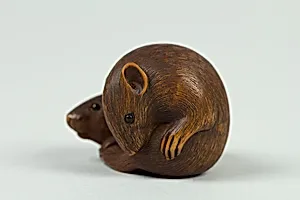
二鼠木彫根付|Netsuke of Two Rats
Unknown Artist
second half of the 19th century
Medium
Wood
Dimensions
H. 1 1/4 in. (3.2 cm); W. 1 1/2 in. (3.8 cm)
Classification
Netsuke
Culture & Period
Japan · Meiji period (1868–1912)
Department
Asian Art
Museum
Metropolitan Museum of Art, New York, NY
Credit
Gift of Mrs. Russell Sage, 1910
Accession Number
10.211.2005
Rights
Public Domain
Tags
Art Historical Context
Nestled in the Metropolitan Museum of Art's Art collection, this charming *Netsuke of Two Rats* is a finely carved wooden toggle from Japan's Meiji period (1868–1912), dating to the second half of 19th century. just 1¼ inches high and 1½ inches wide, its petite scale belies the artisan's skill in capturing the lively forms of two intertwined rats—playful symbols often linked to the Chinese zodiac and tales of cleverness in Japanese folklore. Netsuke like this one served a practical purpose in traditional Japanese dress, acting as a cord fastener to secure inro (small medicine boxes or pouches) to an obi sash, as kimono lacked pockets. Crafted from wood by an unknown artist, it exemplifies the intricate carving techniques of the era, where every whisker and curve was meticulously shaped to create texture and movement. During the Meiji period, as Japan modernized and embraced Western influences, netsuke remained a vibrant folk art form, blending functionality with whimsical expression. Gifted to the Met in 1910 by Mrs. Russell Sage, this piece invites visitors to appreciate the everyday artistry of Meiji Japan, where even the humblest objects spark joy and cultural insight.