
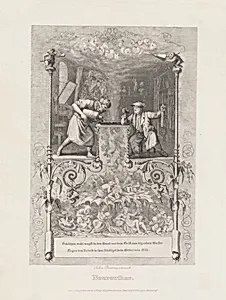
Neureuther (Self-Portrait in the Etching Studio)
Medium
etching on wove paper
Dimensions
plate: 26.2 x 20.4 cm (10 5/16 x 8 1/16 in.) sheet: 34.1 x 25.8 cm (13 7/16 x 10 3/16 in.)
Classification
Department
CG-E
Museum
National Gallery of Art, Washington, D.C.
Credit
Ailsa Mellon Bruce Fund
Accession Number
2005.20.2
Rights
Public Domain
Art Historical Context
In the heart of his etching studio, Eugen Napoleon Neureuther captures himself at work in this intimate 1839 self-portrait, a testament to the Romantic artist's deep bond with his craft. Neureuther (18061882), a prominent German printmaker and illustrator known for his delicate fairy-tale vignettes and landscapes inspired by the Brothers Grimm, here reveals the meticulous world of printmaking. The etching depicts him surrounded by tools and copper plates, embodying the 19th-century ideal of the artist as a solitary genius immersed in creation. Executed as an etching on wove paper—a smooth, fine-textured support ideal for capturing intricate lines—this work showcases Neureuther's mastery of the medium. Etching allowed for fluid, expressive strokes etched into metal plates with acid, producing rich tonal variations that revived the technique during Germany's Romantic etching revival. At 26.2 x 20.4 cm, the plate's modest scale invites close viewing, highlighting details like the artist's focused gaze and scattered implements. Housed in the National Gallery of Art through the Ailsa Mellon Bruce Fund, this print offers a rare glimpse into Neureuther's studio life during a pivotal era when printmaking bridged fine art and illustration, influencing later movements like Symbolism. It's a charming window into the creative process, reminding us how artists like Neureuther immortalized their passion on paper.