
New Bedford, Massachusetts
1860-1870
Medium
watercolor and gouache on wove paper
Dimensions
sheet: 29.85 × 67.63 cm (11 3/4 × 26 5/8 in.)
Classification
Drawing
Department
CG-W
Museum
National Gallery of Art, Washington, D.C.
Credit
Corcoran Collection (Museum Purchase, Membership Association Fund)
Accession Number
2015.19.615
Rights
Public Domain
Art Historical Context
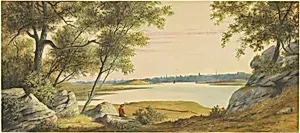
William Allen Wall's *New Bedford, Massachusetts*ca. 1860–1870) captures the bustling whaling port city on Massachusetts' South Coast during its golden age. Rendered in watercolor and gouache onove paper, this panoramic drawing measures nearly 68 cm wide, offering a sweeping vista likely encompassing harbors, ships, and warehouses that defined New Bedford as America's premier whaling hub until petroleum's rise in the 1860s. Wall, a 19th-century American artist known for precise topographic views of New England, skillfully blends translucent watercolors with the opaque vibrancy of gouache to evoke the harbor's luminosity and activity. The artwork's historical significance lies in its snapshot of a pivotal era: post-Civil War prosperity amid industrial transformation. New Bedford's whaling fleet once dominated global seas, fueling lamps and lubricants worldwide, but by the 1860s, decline loomed. Wall's meticulous technique—hallmarks of his draftsmanship—preserves this vanishing maritime world with documentary fidelity, akin to the Hudson River School's attention to American landscapes. Now part of the National Gallery of Art's Corcoran Collection, this piece invites visitors to ponder the interplay of commerce, nature, and progress in antebellum America, its delicate medium highlighting the era's fragile economic tides.