
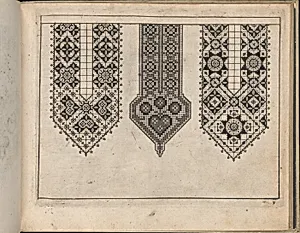
Newes Modelbuch in Kupffer (Page 45r)
1604
Medium
Etching
Dimensions
Overall: 5 11/16 x 7 1/16 x 3/4 in. (14.5 x 18 x 1.9 cm)
Classification
Books|Prints|Ornament & Architecture
Department
Drawings and Prints
Museum
Metropolitan Museum of Art, New York, NY
Credit
Gift of Charles R. Richards, 1929
Accession Number
29.59.3(45r)
Rights
Public Domain
Tags
Art Historical Context
Step into the intricate world of Renaissance ornamentation with *Newes Modelbuch in Kup (Page 45r)* by Johann Sibmacher, a pattern designer from Nuremberg, Germany. Published in 1604, this etching hails from one of the earliest copperplate-printed model books (*Modelbücher*), designed as practical guides for artisans crafting lace, embroidery, weaving, and metalwork. At just 5 11/16 x 7 1/16 inches, this page exemplifies the precision of etching—a technique that allowed Sibmacher to render delicate, repeating motifs with unprecedented clarity and reproducibility. Sibmacher's work revolutionized decorative arts in early 17th-century Europe, bridging fine art and craft by disseminating complex patterns to workshops across the continent. Page 45r likely features geometric or floral ornaments, hallmarks of the period's taste for symmetry and elaboration, inspired by Islamic, Italian, and Gothic influences. These books fueled the ornamental frenzy of the Baroque era, influencing everything from ecclesiastical vestments to domestic textiles. Today, housed in the Metropolitan Museum of Art's Drawings and Prints department (gift of Charles R. Richards, 1929), this modest yet monumental page reminds us how printed patterns democratized beauty, turning skilled hands into creators of lavish splendor. A testament to ingenuity, it invites you to trace the lines that once guided needles and looms.
About the Artist
Johann Sibmacher · 1590–1611
Johann Sibmacher (c. 1561–1611), also rendered as Johann Ambrosius Siebmacher, was a German copperplate engraver, etcher, and publisher based in Nuremberg whose contributions to heraldic art and decorative pattern design left a legacy that outlasted him by centuries. Active from around 1590 until his death in 1611, Sibmacher worked at the heart of Nuremberg's flourishing book and print trade, a ci...