
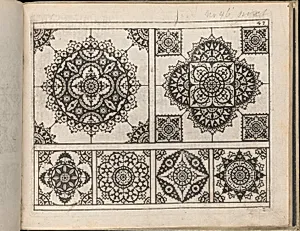
Newes Modelbuch in Kupffer (Page 54r)
1604
Medium
Etching
Dimensions
Overall: 5 11/16 x 7 1/16 x 3/4 in. (14.5 x 18 x 1.9 cm)
Classification
Books|Prints|Ornament & Architecture
Department
Drawings and Prints
Museum
Metropolitan Museum of Art, New York, NY
Credit
Gift of Charles R. Richards, 1929
Accession Number
29.59.3(54r)
Rights
Public Domain
Art Historical Context
Step into the intricate world of Renaissance craftsmanship with *Newes Modelbuch in Kup (Page 54r)* by Johann Sibmacher, master pattern designer from Nuremberg, published in 1604. This etched page is part of an innovative "model book" etched on copper plates, offering precise patterns for embroidery, lace, weaving, and decorative arts. At just 5 11/16 x 7 1/16 inches, its compact format made it a portable treasure for artisans across Europe. Sibmacher's work captures the flourishing ornamental style of the early Baroque era, blending geometric motifs, florals, and strapwork—hallmarks of Northern European design influenced by Italian Renaissance prints. Etching, a relatively new technique at the time, allowed for crisp, reproducible lines far superior to woodcuts, revolutionizing how patterns were shared and adapted. These books democratized high fashion, enabling lacemakers in Venice or embroiderers in England to replicate elite designs. Housed in the Metropolitan Museum of Art's Drawings and Prints department (gift of Charles R. Richards, 1929), this page exemplifies how print technology fueled cultural exchange, turning everyday crafts into art forms that adorned collars, cuffs, and altars alike. A delightful glimpse into the workshops of 17th-century Europe!
About the Artist
Johann Sibmacher · 1590–1611
Johann Sibmacher (c. 1561–1611), also rendered as Johann Ambrosius Siebmacher, was a German copperplate engraver, etcher, and publisher based in Nuremberg whose contributions to heraldic art and decorative pattern design left a legacy that outlasted him by centuries. Active from around 1590 until his death in 1611, Sibmacher worked at the heart of Nuremberg's flourishing book and print trade, a ci...