
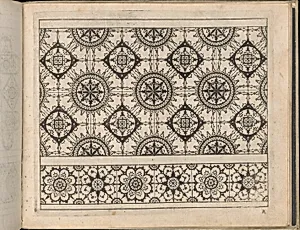
Newes Modelbuch in Kupffer (Page 57r)
1604
Medium
Etching
Dimensions
Overall: 5 11/16 x 7 1/16 x 3/4 in. (14.5 x 18 x 1.9 cm)
Classification
Books|Prints|Ornament & Architecture
Department
Drawings and Prints
Museum
Metropolitan Museum of Art, New York, NY
Credit
Gift of Charles R. Richards, 1929
Accession Number
29.59.3(57r)
Rights
Public Domain
Tags
Art Historical Context
Step into the intricate world of Renaissance craftsmanship with *Newes Modelbuch in Kup (Page 57r)* by Johann Sibmacher, a Nuremberg engraver whose 1604 etching captures the era's passion for ornamentation. This page from his "New Pattern Book in Copper" showcases delicate motifs—likely floral, geometric, or architectural designs—intended as templates for artisans. Measuring a compact 5 11/16 x 7 1/16 inches, it's a testament to the portability of knowledge in an age before mass printing dominated. Pattern books like Sibmacher's were revolutionary, democratizing high-style decoration for lace-makers, embroiderers, and woodworkers across Europe. Produced during the late Renaissance, they bridged art and craft, influencing everything from sumptuous court attire to domestic textiles. Sibmacher's volumes, etched on durable copper plates, spread these patterns far beyond workshops, fueling the decorative arts boom as trade and exploration expanded tastes. The etching technique here shines: acid-etched lines on copper allowed for crisp, repeatable precision unattainable by woodcuts, marking a pivotal shift in printmaking for design dissemination. Today, at the Metropolitan Museum of Art (gift of Charles R. Richards, 1929), this leaf invites us to trace the threads of history—where a single page sparked countless creations.
About the Artist
Johann Sibmacher · 1590–1611
Johann Sibmacher (c. 1561–1611), also rendered as Johann Ambrosius Siebmacher, was a German copperplate engraver, etcher, and publisher based in Nuremberg whose contributions to heraldic art and decorative pattern design left a legacy that outlasted him by centuries. Active from around 1590 until his death in 1611, Sibmacher worked at the heart of Nuremberg's flourishing book and print trade, a ci...