
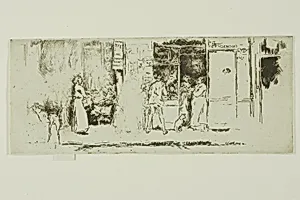
Newspaper-Stall, Rue de Seine
Medium
Etching in dark brown ink on light gray laid paper
Dimensions
Sheet excluding tab: 8.4 × 20 cm (3 5/16 × 7 7/8 in.); Sheet including tab: 8.8 × 20 cm (3 1/2 × 7 7/8 in.)
Classification
etching
Department
Prints and Drawings
Museum
Art Institute of Chicago
Accession Number
137984
Rights
Public Domain
Art Historical Context
Step into the bustling streets of late 19th-century Paris with James McNeillistler's *Newspaper-Stall, Rue de* (1893), a delicate etching that captures the everyday vibrancy of the city's Left Bank. Whistler, the American-born artist renowned for his Aesthetic movement ideals—prioritizing "art for art's sake" through subtle harmonies of tone and form—turned his keen eye to urban scenes like this one. The Rue de Seine, a lively artery near the Seine River, comes alive here with the modest charm of a newspaper stall, evoking the fleeting moments of Parisian life amid Whistler's late-career fascination with street vendors and passersby. Crafted as an etching in dark brown ink on light gray laid paper, this intimate print (just 8.4 × 20 cm excluding the tab) showcases Whistler's mastery of intaglio techniques. He incised fine lines into a metal plate, allowing acid to etch subtle textures that, when inked and printed, yield a soft, atmospheric depth. The unconventional gray paper enhances the ink's warm glow, creating a moody interplay of light and shadow that anticipates modern printmaking's expressive potential. Housed in the Art Institute of Chicago's Prints and Drawings collection, this work exemplifies Whistler's influence on Symbolism and Japonisme, blending precise observation with poetic suggestion. It's a window into how one artist transformed ordinary commerce into timeless elegance, inviting us to linger over the nuances of daily Paris.
About the Artist
James McNeill Whistler · 1834–1903
James Abbott McNeill Whistler (1834-1903) was an American-born painter and printmaker who became a leading figure in the Aesthetic Movement and pioneer of Tonalism and Japonisme. He revolutionized art by championing "art for art's sake" and treating paintings as visual equivalents of musical compositions, titling works as "arrangements," "harmonies," and "nocturnes" to emphasize formal qualities o...