
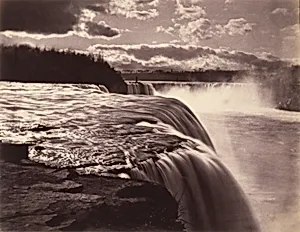
Niagara Falls, from the American Side
ca. 1870
Medium
Photography-Photoprint
Classification
Photography-Photoprint
Department
Smithsonian Collection
Museum
Smithsonian American Art Museum
Credit
Smithsonian American Art Museum, Museum purchase from the Charles Isaacs Collection made possible in part by the Luisita L. and Franz H. Denghausen Endowment
Accession Number
1994.91.22
Rights
Public Domain
Tags
Art Historical Context
In the late 19th century, Falls captivated the American imagination as a symbol of nature's sublime power, drawing tourists, artists, and scientists alike. Charles Bierstadt *Niagara Falls, from the Side* (ca. 1870) captures this iconic vista from the New York shoreline, prominently featuring the Terrapin Tower—a wooden observation platform on Goat Island built in 1833. As a pioneering photographer and brother to landscape painter Albert Bierstadt, used photoprint techniques to document thundering cascades with remarkable clarity, preserving a moment just before the tower's demolition in 1870 due to structural decay. This photoprint exemplifies the era's photographic revolution, where albumen processes allowed for detailed, large-scale images that rivaled paintings in their ability to convey scale and drama. Part of the Smithsonian American Art Museum's collection, it highlights photography's role in democratizing access to distant wonders, fueling tourism and national pride in America's natural heritage. Visitors today can appreciate how Bierstadt's work bridged art and science, offering a frozen glimpse of Niagara's raw energy and the fleeting human structures that framed it—reminding us of nature's enduring dominance.