
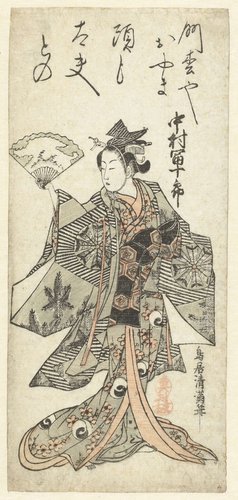
Nieuwjaarsdans
Medium
color woodcut
Dimensions
142; 311
Rights
Public Domain
About this artwork
kleurenhoutsnede; lijnblok in zwart met kleurblokken in roze en grijs
Art Historical Context
**Nieuwjaarsdans (New Year's Dance)** by Torii Kiyom I (1734–1785) captures the joyous spirit of Japanese New Year celebrations in 1753, during the vibrant Edo period. As a leading figure in the Torii school ukiyo-e— depicting the "floating world" of theater, beauty, and urban pleasures—Kiyomitsu specialized in dynamic yakusha-e (actor). This tall, narrow *hashira-e* ( print), measuring 311 mm high by 142 mm wide, designed to be posted on architectural pillars, immersing passersby in festive scenes likely featuring graceful dancers or kabuki performers ushering in the New Year with rhythmic movements and traditional attire. Printed as a *benizuri-e* (rose-colored print), it employs an innovative early color woodblock technique: a black line block for bold outlines, overlaid with subtle pink and gray color blocks. This method, pioneered in the mid-18th century, marked a shift from monochromatic *sumizuri-e* toward multicolored splendor, making art accessible to everyday Edoites through affordable, mass-produced sheets. Culturally, *Nieuwjaarsdans* reflects New Year's (*shōgatsu*) rituals, symbolizing renewal and community revelry amid Japan's thriving woodblock print culture. Kiyomitsu's expressive lines and harmonious palette evoke the ephemeral beauty of the season, offering visitors a window into 18th-century Japan's theatrical exuberance.