
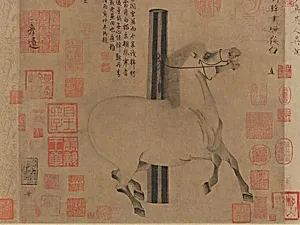
唐 韓幹 照夜白圖 卷|Night-Shining White
ca. 750
Medium
Handscroll; ink on paper
Dimensions
Image: 12 1/8 x 13 3/8 in. (30.8 x 34 cm) Overall with mounting: 14 in. x 37 ft. 5 1/8 in. (35.4 cm x 11.4 m)
Classification
Paintings
Culture & Period
China · Tang dynasty (618–907)
Department
Asian Art
Museum
Metropolitan Museum of Art, New York, NY
Credit
Purchase, The Dillon Fund Gift, 1977
Accession Number
1977.78
Rights
Public Domain
Tags
Art Historical Context
Behold *Night-Shining White* (*Zhao Ye Bai*), a masterful handscroll by Tang dynasty artist Han Gan, created around 750 CE. During the Tang era (618–907), called China's golden age of art and culture, horses symbolized power, speed, and imperial prestige. Han Gan, a court painter favored by Emperor Xuanzong, in equine portraits, capturing the nobility and vitality of these creatures with unparalleled realism. This ink-on-paper depiction portrays the emperor's legendary white steed, Bai Long ("Night-Shining White"), rearing dynamically against a vast, empty background that amplifies its majestic presence. The handscroll format—measuring just 12⅛ x 13⅜ inches for the image but extending over 37 feet when fully unrolled—invites intimate, sequential viewing, a hallmark of Chinese painting traditions. Han's technique employs fluid ink washes and precise lines to convey the horse's muscular anatomy, glossy coat, and spirited energy, evoking motion without color. Acquired by the Metropolitan Museum of Art in 1977, this treasure exemplifies Tang innovation in figure painting, influencing generations of artists. Fun fact: Legends say Han Gan studied horses by living in stables, achieving such lifelike detail that viewers felt the animals might leap off the page. A must-see for horse lovers and art enthusiasts alike!