
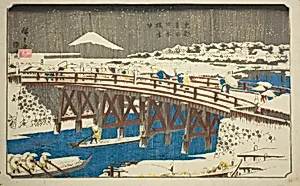
Nihon Bridge in Snow (Nihonbashi setchu), from the series "Famous Places in the Eastern Capital (Toto meisho)"
c. 1842/44
Medium
Color woodblock print; oban
Dimensions
23.5 × 37.5 cm (9 1/4 × 14 3/4 in.)
Classification
woodblock print
Department
Arts of Asia
Museum
Art Institute of Chicago
Accession Number
33924
Rights
Public Domain
Art Historical Context
In the snowy hush of Edo (modern-day Tokyo), Utagawa Hiroige captures the iconic Nihonbashi bridge in his color woodblock print *Nihonbashi setchu* (Nihon Bridge in Snow), from the series *Toto meisho* (Famous Places in the Capital), created around 1842–44. As a master of ukiyo—the "pictures of the floating world"—Hiroshige landscape prints with his poetic sensitivity to nature and urban life. This oban print (23.5 × 37.5 cm) depicts the bustling bridge, a vital commercial hub linking merchants and travelers, blanketed in winter's gentle snowfall. Hiroshige's genius shines in his innovative use of woodblock techniques: multiple carved blocks layered delicate colors to evoke the soft grays and whites of snow, contrasted by warm lantern glows and distant rooftops. His atmospheric perspective draws the eye from foreground figures—bundled pedestrians and porters—to the hazy horizon, blending human activity with seasonal beauty. Held in the Art Institute of Chicago's Arts of Asia collection, this print exemplifies Edo-period Japan's vibrant print culture, making art accessible to all classes. It immortalizes a fleeting moment, reminding us of Hiroshige's enduring influence on artists from Whistler to Van Gogh. (198 words)
About the Artist
Utagawa Hiroshige · 1826–1869
Utagawa Hiroshige (1797–1858), born Andō Tokutarō, was the last great master of Japanese ukiyo-e woodblock printmaking and one of the most influential landscape artists in history. Born in Edo (modern Tokyo) into a low-ranking samurai family serving as fire wardens, Hiroshige transformed landscape printmaking into a poetic meditation on nature, weather, and everyday life. His revolutionary approac...