
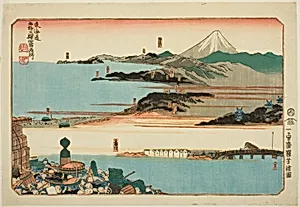
Nihonbashi, Shinagawa, Kawasaki, and Kanagawa, from the series "Famous Places on the Fifty-three Stations of the Tokaido, Four Stations (Tokaido gojusan eki yonshuku meisho)"
c. 1830/35
Medium
Color woodblock print; oban
Dimensions
25.9 × 38 cm (10 3/16 × 14 15/16 in.)
Classification
woodblock print
Department
Arts of Asia
Museum
Art Institute of Chicago
Accession Number
9872
Rights
Public Domain
Art Historical Context
Behold *Nihonbashi, Shinagawa, Kawasaki, and Kanagawa*, a vibrant color woodblock print by Utagawa Kuniyoshi, created around 1830–35. Part of the series *Famous Places on the Fifty-three Stations of theokaido, Four StationsTokaido gojusan eki yonshuku meisho)*, this oban-sized work (25.9 × 38 cm) captures iconic stops along the historic Tokaido road—the vital coastal route linking Edo (modern Tokyo) to Kyoto during Japan's Edo period (1603–1868). Kuniyoshi, a master of the Utagawa school and ukiyo-e tradition, here shifts from his renowned warrior prints to evoke the bustling energy of travel and urban life. The Tokaido's 53 stations were post stops for samurai, merchants, and pilgrims, immortalized in popular art to satisfy a growing fascination with scenic journeys amid Japan's isolationist sakoku policy. This print showcases four early stations: Nihonbashi's bridge gateway, Shinagawa's teahouses, Kawasaki's shrines, and Kanagawa's ports, blending precise landscapes with human activity in dynamic compositions. Kuniyoshi's woodblock technique—carving intricate blocks for layered colors—produced affordable, mass-reproduced images that democratized art. Housed in the Art Institute of Chicago's Arts of Asia department, it exemplifies ukiyo-e's cultural role in preserving everyday splendor, offering visitors a window into 19th-century Japan's wanderlust and artistry.
About the Artist
Utagawa Kuniyoshi · 1797–1861
Utagawa Kuniyoshi (1797–1861) was born in Edo to the silk-dyer Yanagiya Kichiyemon, originally bearing the childhood name Yoshisaburō. From a young age, he assisted in his family's pattern design work, which sharpened his innate mastery of color and textile motifs that would permeate his later prints. At around twelve years old, his prodigious drawing skills drew the attention of the renowned Utag...