
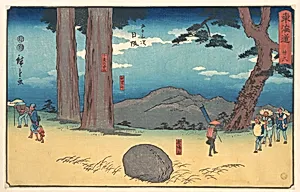
東海道五十三次 日阪 夜啼石 無間山 小夜の中山|Nissaka
ca. 1848–49
Medium
Woodblock print; ink and color on paper
Dimensions
Overall: 8 3/4 x 13 3/4in. (22.2 x 34.9cm)
Classification
Prints
Culture & Period
Japan · Edo period (1615–1868)
Department
Asian Art
Museum
Metropolitan Museum of Art, New York, NY
Credit
The Francis Lathrop Collection, Purchase, Frederick C. Hewitt Fund, 1911
Accession Number
JP776
Rights
Public Domain
Tags
Art Historical Context
Utagawa Hiroshige1797–1858), a master of ukiyo-e woodblock prints, captures the dramatic beauty of Japan's Tōkaidō road in this evocative scene from his renowned series *The Fifty-three of the Tōkaidō* (ca. 1848–49). Titled *Nissaka*—referencing the station's steep paths through Yobaiishi (Night-Crying Stone), Mugen'yama (Endless Mountain), and Koyasu no Nakayama (Little Night Pass)—this print depicts travelers navigating a misty, forested hillside. Men and women, rendered in flowing robes, evoke the era's pilgrimage culture during the Edo period (1615–1868), when the Tōkaidō linked Edo (modern Tokyo) to Kyoto, fostering commerce and wanderlust. Hiroshige's genius lies in his atmospheric landscapes, where subtle gradients of ink and vibrant colors—achieved through collaborative woodblock printing—convey mood and movement. The looming hills and twisted trees heighten a sense of eerie mystery, drawing on local legends of ghostly cries echoing from the stones at night. This affordable art form democratized scenic beauty, inspiring global artists like Van Gogh and Whistler. From The Metropolitan Museum of Art's Francis Lathrop Collection, this 8¾ × 13¾-inch print exemplifies ukiyo-e's ("pictures of the floating world") cultural pinnacle, blending everyday travel with supernatural allure for Edo Japan's avid print collectors.
About the Artist
Utagawa Hiroshige · 1826–1869
Utagawa Hiroshige (1797–1858), born Andō Tokutarō, was the last great master of Japanese ukiyo-e woodblock printmaking and one of the most influential landscape artists in history. Born in Edo (modern Tokyo) into a low-ranking samurai family serving as fire wardens, Hiroshige transformed landscape printmaking into a poetic meditation on nature, weather, and everyday life. His revolutionary approac...