
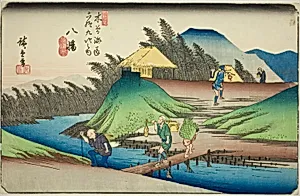
No. 25: Yawata, from the series "Sixty-nine Stations of the Kisokaido (Kisokaido rokujukyu tsugi no uchi)"
c. 1835/38
Medium
Color woodblock print; oban
Dimensions
22.9 × 35.2 cm (9 × 13 7/8 in.)
Classification
woodblock print
Department
Arts of Asia
Museum
Art Institute of Chicago
Accession Number
36437
Rights
Public Domain
Art Historical Context
Utagawa Hiroshige's *No. 25: Yawata, from the "Sixty-nine Stations the Kisokaido"*c. 1835/38) captures the essence travel along Japan's historic Kisokaido route, an inland highway connecting Edo (modern Tokyo) to Kyoto This color woodblock print, in the popular oban format (22.9 × 35.2 cm), is part of a renowned series the 69 post stations dotted the path—rivaling Hiroshige's earlier Tokaido series. Produced the Edo period, these prints reflected the era's fascination with *ukiyo-e* ("pictures of the floating world"), blending everyday journeys with poetic landscapes. Hiroshige, a master of the ukiyo-e school, excelled in atmospheric effects, using subtle gradations of color achieved through the intricate woodblock technique. Multiple carved blocks were inked in vibrant hues—blues for misty skies, greens for lush hills—and precisely overlaid by skilled printers, creating depth and movement on washi paper. Yawata, the 25th station, likely evokes the town's bustling inns and surrounding scenery, inviting viewers to imagine weary travelers resting amid nature's beauty. These prints were affordable art for the masses, popularizing landscape imagery and later inspiring Western artists like Vincent van Gogh. Today, at the Art Institute of Chicago, it stands as a window into 19th-century Japan's wanderlust and artistic innovation.
About the Artist
Utagawa Hiroshige · 1826–1869
Utagawa Hiroshige (1797–1858), born Andō Tokutarō, was the last great master of Japanese ukiyo-e woodblock printmaking and one of the most influential landscape artists in history. Born in Edo (modern Tokyo) into a low-ranking samurai family serving as fire wardens, Hiroshige transformed landscape printmaking into a poetic meditation on nature, weather, and everyday life. His revolutionary approac...