
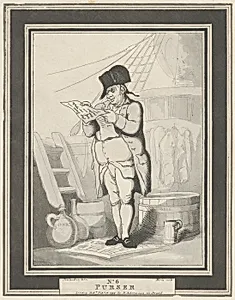
No. 6: Purser
February 15, 1799
Medium
Etching and aquatint
Dimensions
Sheet (trimmed and inset): 9 15/16 × 7 3/4 in. (25.2 × 19.7 cm)
Classification
Prints
Department
Drawings and Prints
Museum
Metropolitan Museum of Art, New York, NY
Credit
The Elisha Whittelsey Collection, The Elisha Whittelsey Fund, 1959
Accession Number
59.533.1881
Rights
Public Domain
Tags
Art Historical Context
**No. 6: Purser** (1799) is a lively satirical print by the renowned British caricaturist Thomas Rowland, with etching and aquatint by Merke and published by Rudolph Ackermann in London. Created during the Napoleonic Wars, when Britain's Royal Navy dominated the seas, this work captures the everyday quirks of maritime life. The aquatint technique—Rowlandson's specialty—adds rich tonal depth and subtle shading, mimicking watercolor effects on paper, while etching provides crisp lines for humorous details. Measuring about 10 by 7 3/4 inches, it's part of The Elisha Whittelsey Collection at the Metropolitan Museum of Art. As the sixth in a presumed series, it spotlights the "purser," the ship's supply officer often stereotyped in Georgian satire as a penny-pinching bureaucrat amid rugged sailors. Tags evoke a scene of men—likely sailors—absorbed in reading, perhaps ledgers or orders, poking fun at naval hierarchy and the era's obsession with discipline and literacy. Rowlandson's exaggerated style, rooted in the caricature tradition, entertains while reflecting 18th-century British culture, where prints like Ackermann's were affordable amusements for the middle class, blending wit with social commentary on seafaring adventures and mishaps. A charming glimpse into history's humorous undercurrents!
About the Artist
Thomas Rowlandson|Henri Merke|Rudolph Ackermann, London · 1756–1827
Thomas Rowlandson (1757–1827) was an English artist and caricaturist whose satirical watercolors and prints captured the social life of Georgian Britain with unparalleled wit and technical mastery. Alongside James Gillray, he is recognized as one of the greatest British graphic artists, and his distinctive flowing line and keen observations have made his work integral to understanding late 18th an...