
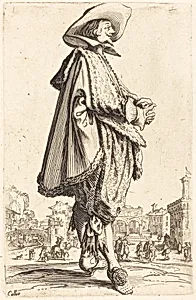
Noble Man with Folded Hands
c. 1620/1623
Medium
etching on laid paper
Dimensions
plate: 15.3 × 10 cm (6 × 3 15/16 in.) sheet: 18.5 × 13 cm (7 5/16 × 5 1/8 in.)
Classification
Department
CG-E
Museum
National Gallery of Art, Washington, D.C.
Credit
R.L. Baumfeld Collection
Accession Number
1969.15.538
Rights
Public Domain
Art Historical Context
Jacques Callot's *Noble Man with Folded Hands*, created around 1620-1623, exemplifies the exquisite precision of early Baroque printmaking. This etching on laid paper captures a dignified figure in contemplative repose, his hands clasped in a gesture evoking quiet nobility and introspection. Measuring just 15.3 × 10 cm on the plate, the intimate scale invites close viewing, revealing Callot's mastery of lines and intricate detailing—hallmarks of his innovative etching technique. A leading French printmaker who trained in Italy and served the Medici court in Florence, Callot revolutionized etching with his use of multiple biting stages and textured grounds, allowing unprecedented depth and texture in small formats. This work likely belongs to his series of character studies, blending portraiture with genre elements to portray social types from the era's aristocracy. Etchings like this were prized for their reproducibility, disseminating elegant imagery across Europe during the tumultuous Thirty Years' War period. Housed in the National Gallery of Art's R.L. Baumfeld Collection, this print highlights Callot's enduring influence on later artists like Rembrandt. For visitors, it offers a window into 17th-century courtly life, where folded hands symbolized piety or restraint amid opulence.
About the Artist
Jacques Callot · 1592–1635
Jacques Callot (1592–1635) was a French printmaker and draftsman from the Duchy of Lorraine, widely regarded as one of the first great artists to practice the graphic arts exclusively. His more than 1,400 etchings chronicled the breadth of 17th-century life, from Medici court festivities to the brutal realities of warfare. Callot revolutionized etching through technical innovations including the é...