
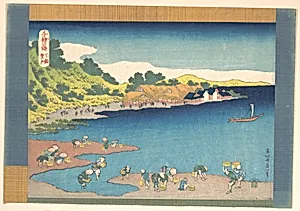
千絵の海 下総登戸|Noboto at Shimōsa (Shimōsa Noboto), from the series One Thousand Pictures of the Sea (Chie no umi)
1832–33
Medium
Woodblock print; ink and color on paper
Dimensions
H. 7 1/4 in. (18.4 cm); W. 10 in. (25.4 cm)
Classification
Prints
Culture & Period
Japan · Edo period (1615–1868)
Department
Asian Art
Museum
Metropolitan Museum of Art, New York, NY
Credit
Henry L. Phillips Collection, Bequest of Henry L. Phillips, 1939
Accession Number
JP2920
Rights
Public Domain
Tags
Art Historical Context
Katsushika Hokus, the legendary Japanese artist renowned for his ukiyo-e woodblock prints, created *Noboto at Shimōsa (Shimōsa Noboto)* around 1832–33 as part of his ambitious series *One Thousand Pictures the Sea (Chie no umi)*. During Japan's Edo period (16151868), ukiyo-e prints like this one captured the "floating world" of everyday beauty, blending realism with poetic imagination. Hokusai, then in his seventies, envisioned producing a thousand designs celebrating the sea's majesty, though only a handful were realized—making this print a rare gem from that visionary project. This intimate vertical-format print (7¼ × 10 inches) depicts a serene coastal scene at Noboto in the Shimōsa region, evoking beaches and expansive landscapes through masterful ink and color on paper. Hokusai's genius shines in his dynamic composition: waves crash rhythmically, boats dot the horizon, and distant mountains add depth, all achieved via the collaborative woodblock process where carvers and printers brought his bold lines and vibrant hues to life. The technique's precision allowed affordable dissemination, popularizing nature's drama among urban dwellers. Housed in the Metropolitan Museum of Art's Asian Art Department from the Henry L. Phillips Collection, this work exemplifies Hokusai's enduring influence on global art, inspiring Impressionists like Monet. It invites visitors to ponder the sea's timeless allure, a cultural touchstone of Japan's artistic golden age.
About the Artist
Katsushika Hokusai · 1760–1849
Katsushika Hokusai (1760-1849) stands as one of history's most influential artists, a Japanese master who revolutionized the ukiyo-e woodblock print tradition and profoundly shaped Western art. Born in the Katsushika district of Edo (modern-day Tokyo) to an artisan family, Hokusai lived through nearly nine decades of extraordinary creative evolution, adopting over thirty different artistic names t...