
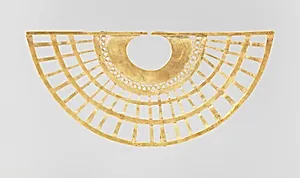
Nose Ornament
Unknown Artist
1st century BCE–2nd century CE
Medium
Gold
Dimensions
H. 1 x W. 2 1/4 x D. 1/16 in. (2.5 x 5.7 x 0.1 cm)
Classification
Metal-Ornaments
Culture
Salinar (?)
Department
Arts of Africa, Oceania, and the Americas
Museum
Metropolitan Museum of Art, New York, NY
Credit
The Michael C. Rockefeller Memorial Collection, Bequest of Nelson A. Rockefeller, 1979
Accession Number
1979.206.1173
Rights
Public Domain
Art Historical Context
This delicate Nose Ornament, crafted from a thin sheet of gold, hails from Peru's north coast and dates to the 1 century BCE–2nd CE. Attributed tentatively to the Salinar culture early Andean society known for its transitional metalworking between earlier Cupisnique and later M traditions—this tiny treasure measures just 1 inch high, 2¼ inches wide, and /16 inch deep. Its shimmering surface and precise proportions reflect the high value placed on gold in pre-Columbian Americas, where the metal symbolized solar divinity and elite prestige. In ancient Andean communities, nose ornaments like this were pierced through the septum and worn by nobility during rituals and ceremonies, signaling social rank and spiritual power. The Salinar phase, part of Peru's Early Intermediate Period, saw innovations in goldsmithing, with artisans hammering malleable sheets into lightweight, wearable forms that balanced beauty and functionality. This piece's fragility underscores the skill required to create such enduring finery. Now in The Metropolitan Museum of Art's Arts of Africa, Oceania, and the Americas department, it forms part of The Michael C. Rockefeller Memorial Collection (1979 bequest). Visitors can marvel at how this unassuming jewel reveals the sophistication of Salinar craftsmanship and the cultural reverence for adornment.