
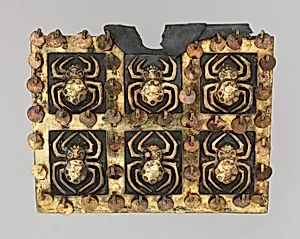
Nose ornament with spiders
200–900 CE
Medium
Gold, silver, shell
Dimensions
H. 2 5/8 x W. 3 3/8 x D. 1/4 in. (6.7 x 8.6 x 0.6 cm)
Classification
Metal-Ornaments|Shell-Ornaments
Culture
Moche
Department
Arts of Africa, Oceania, and the Americas
Museum
Metropolitan Museum of Art, New York, NY
Credit
The Michael C. Rockefeller Memorial Collection, Bequest of Nelson A. Rockefeller, 1979
Accession Number
1979.206.1230
Rights
Public Domain
Tags
Art Historical Context
This exquisite nose ornament, crafted by Moche artists between 200–900 CE, hails from the ancient Moche culture of Peru's northern coast. The Moche, a pre-Inca civilization renowned for their masterful metalworking and vivid depictions of mythology and nature, created such jewelry for elite individuals. Worn through a pierced septum, this small yet striking piece (just 2⅝ x 3⅜ inches) served as a visible symbol of status and power, adorning the faces of priests, warriors, or rulers during rituals or ceremonies. Fashioned from hammered sheets of gold and silver with delicate shell inlays, the ornament showcases the Moche's advanced techniques, including repoussé work to form the intricate spider motifs. Spiders, rendered with lifelike detail, likely held symbolic importance—perhaps evoking weaving, fertility, or underworld forces central to Moche cosmology, as seen in their ceramics and textiles. The combination of precious metals, which the Moche skillfully alloyed and gilded, underscores their metallurgical prowess and reverence for materials sourced from distant Andean mines. Now part of The Michael C. Rockefeller Memorial Collection at The Metropolitan Museum of Art, this artifact offers a glimpse into Moche artistry's blend of beauty and belief, inviting visitors to ponder the wearer's world of ancient rituals and reverence for the natural realm.